 Français
 English

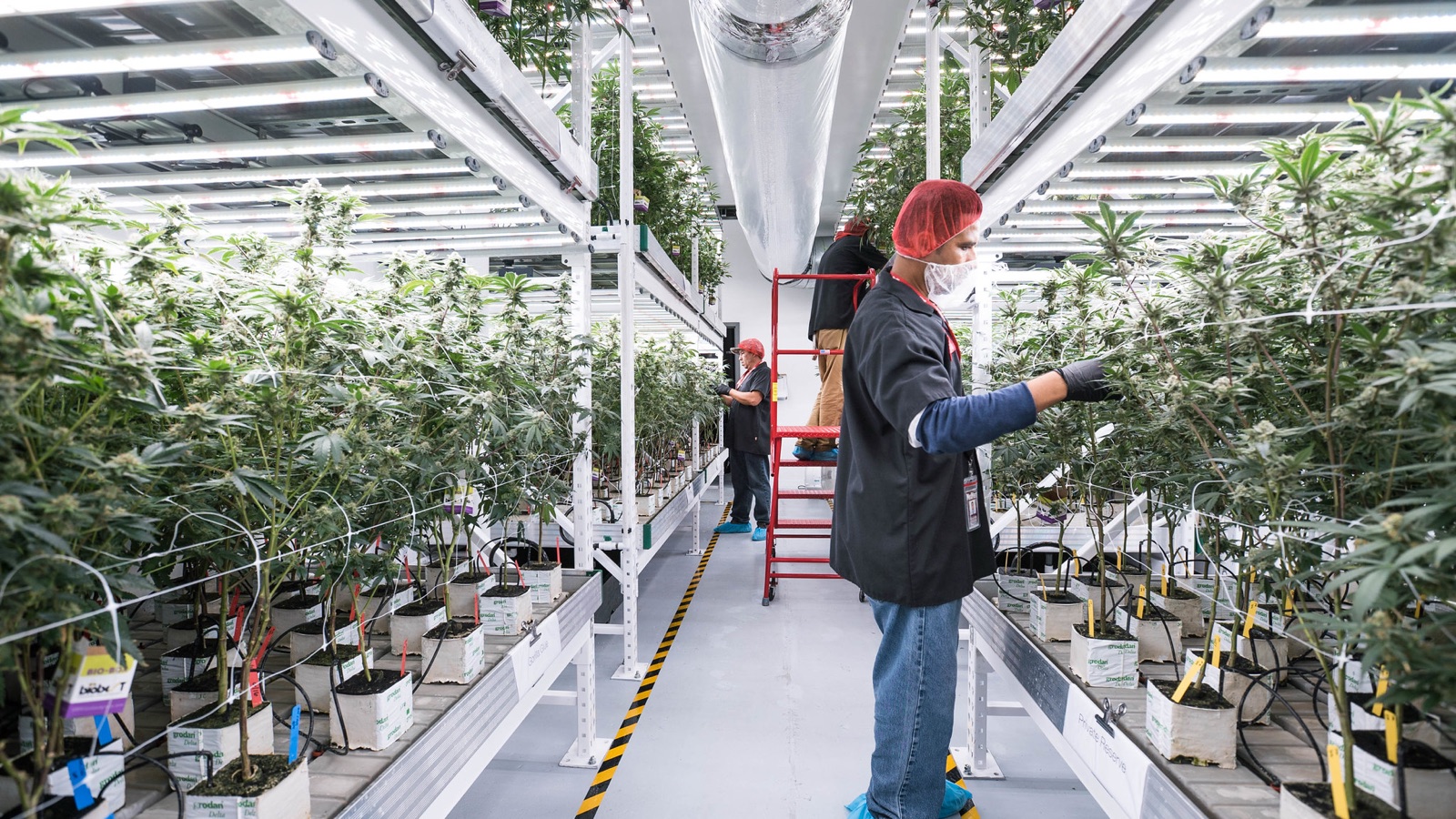
Vertical farming makes efficient use of floor area by placing crops on multiple growing tiers. The same arrangement that increases production density also creates one of the most difficult air-distribution problems in controlled-environment agriculture: every tier must receive an appropriate amount of conditioned air, even though heat, moisture, lighting, and plant density vary throughout the rack.
A successful vertical farming HVAC design must therefore do more than deliver a calculated volume of air to the room. It must control Vapor Pressure Deficit (VPD) at the canopy, manage sensible and latent loads, limit stratification, and provide airflow uniformity across the full height and length of the growing system.
Engineered fabric duct is a practical solution when it is designed around the rack geometry rather than treated as a generic replacement for metal ductwork.
Why Vertical Farming Creates Tier-to-Tier Climate Differences
In a conventional single-level room, the designer can often evaluate air temperature and relative humidity at several points around the occupied space. In a vertical farm, the growing environment is three-dimensional. Each tier has its own relationship to:
- LED fixtures and their sensible heat output
- Plant transpiration and latent moisture
- Adjacent aisles and equipment
- Supply outlets and return-air paths
- Buoyant air movement caused by temperature differences
- Physical obstructions created by trays, shelves, and dense canopies
Warm air naturally rises. If the supply system introduces most of its air near the upper portion of a rack, the top tier may receive excessive cooling while lower levels remain stagnant. In another layout, heat from lighting may accumulate above the canopy, while humid air remains trapped around leaves below.
The result is not always obvious from a room-level average. A room may show an acceptable temperature and relative humidity while individual tiers experience different VPD values, leaf temperatures, and transpiration rates.
That is why airflow uniformity must be evaluated at the growing tier: not only at the air handler or central room sensor.
VPD Is a Leaf-Level HVAC Design Requirement
VPD describes the drying potential of the air around a plant. More precisely, it is the difference between the moisture pressure at saturation at the leaf temperature and the actual vapor pressure in the surrounding air.
A simplified relationship is:
VPD = saturation vapor pressure at leaf temperature – actual vapor pressure of air
Actual vapor pressure depends on air temperature and relative humidity. Leaf temperature is also important because a leaf exposed to lighting or insufficient air movement may not match the surrounding dry-bulb temperature.
VPD influences transpiration, nutrient transport, stomatal behavior, and disease risk. A high VPD can increase water loss and place stress on the crop. A low VPD can reduce transpiration and create humid conditions around the leaf surface.
For many crops and growth stages, designers may work within a general target range such as 0.8 to 1.2 kPa, but the correct value depends on the crop, cultivar, lighting strategy, and production stage. The HVAC system must be capable of maintaining the selected target across the rack: not just at a single wall-mounted sensor.
This requires coordinated control of:
- Supply-air temperature
- Relative humidity and dehumidification
- Canopy-level air velocity
- Leaf temperature
- Lighting schedules
- Stage-specific climate recipes
The Prihoda indoor agriculture application guide explains how engineered fabric duct systems support VPD control, transpiration, and uniform conditions in vertical farms and other CEA environments.
Airflow Uniformity Starts With the Boundary Layer
A leaf naturally develops a thin layer of relatively still air along its surface. This is called the boundary layer. When the boundary layer becomes too thick, heat and water vapor do not move efficiently away from the leaf. Local humidity can rise even when the room’s average relative humidity appears acceptable.
Gentle, consistent air movement reduces the boundary layer and supports more predictable transpiration. The objective is not to create a strong jet directed at the crop. Excessive velocity can increase mechanical stress, dry leaf edges, and produce uneven conditions from one side of the canopy to the other.
The distribution system should instead provide air that:
- Reaches the intended rack elevation.
- Mixes with room air before contacting the canopy.
- Maintains appropriate velocity at leaf level.
- Continues moving through the rack toward the return path.
- Avoids dead zones behind fixtures, shelves, and dense foliage.
A fabric duct system can achieve this through a combination of permeable fabric, precision perforations, linear vents, and nozzles. The correct discharge pattern depends on the required air throw, available installation space, rack height, tier spacing, and supply-air conditions.
Design Air Throw for the Actual Rack Geometry
Air throw is the distance conditioned air travels from the discharge point before its velocity decays to the desired level. In a vertical farm, that distance is rarely the same as in an open warehouse or greenhouse.
A duct positioned several feet from a rack may need to throw air across an aisle and then distribute it through a canopy. A duct installed directly between two rack faces may require a shorter, lower-velocity discharge. A top-tier supply pattern may need to avoid short-circuiting directly into a nearby return, while a lower-tier pattern may need to overcome obstructions created by trays and lighting.
These conditions make generic outlet spacing unreliable.
For example, a design may use:
- Larger directional openings where air must cross a wide aisle
- Smaller perforations where the duct is close to the canopy
- Linear vents for a controlled plane of air along a rack face
- Staggered discharge locations to serve different elevations
- Permeable sections to soften the transition between direct outlets
- Separate duct runs or zones where tier loads differ significantly
The important point is that discharge patterns should be selected from calculated air-throw requirements. A fabric duct is not automatically uniform simply because it is made of fabric. Its performance depends on the relationship between static pressure, duct diameter, CFM, outlet geometry, and the surrounding space.
Match the Air Distribution to Sensible and Latent Loads
Vertical farming HVAC systems must handle two different categories of heat load.
Sensible loads include heat from LED fixtures, motors, pumps, fans, people, equipment, and the building envelope. These loads raise dry-bulb temperature.
Latent loads come primarily from plant transpiration, irrigation, infiltration, and moisture introduced during cleaning or production activities. These loads increase the amount of water vapor that must be removed.
A system selected only by total cooling capacity may not control VPD effectively. The equipment must have sufficient latent capacity during high-transpiration periods, while also managing sensible heat from lighting. During lights-off periods, latent removal may remain necessary even after the largest sensible load has disappeared. Reheat, dedicated dehumidification, or other coordinated control strategies may be required to prevent overcooling the crop while reducing humidity.
The air-distribution system supports this process by delivering dehumidified and conditioned air across the complete growing volume. If supply air reaches only the upper tier, humidity near lower canopies may remain elevated despite adequate dehumidifier capacity.
Return placement matters as well. Supply and return locations should establish a deliberate airflow path through the racks, not allow conditioned air to bypass the crop and return directly to the air handler.
Use AirTailor® to Model the System Before Installation
A vertical farm is difficult to correct after the racks, lighting, irrigation, and mechanical systems are installed. Air distribution should be reviewed while the layout can still be changed.
Prihoda uses its proprietary AirTailor® design software to evaluate the application, required airflow, installation height, duct dimensions, pressure losses, discharge direction, and target velocity. The design process produces graphical airflow profiles that show how velocity changes as air moves away from the diffuser.
For a vertical farming HVAC project, the model should account for:
- Rack length, width, and tier elevation
- Aisle dimensions and obstructions
- Lighting heat and fixture locations
- Supply and return locations
- Required CFM by zone
- Target air velocity at the canopy
- Temperature and humidity setpoints
- Crop stage and expected transpiration
- Cleaning and fabric removal requirements
For more critical applications, Prihoda can also use computational fluid dynamics to evaluate room-level airflow, temperature patterns, heat sources, equipment, supply points, and returns. This provides a clearer view of potential stratification and stagnant areas before fabrication begins.
Fabric Duct Supports Flexible CEA Facility Design
Vertical farms are frequently built in warehouses, insulated rooms, retrofits, and modular facilities. Structural capacity, ceiling height, sanitation procedures, and future rack expansion can all influence the HVAC layout.
Fabric duct provides several practical advantages in these environments:
- Lightweight construction reduces structural loading.
- Custom lengths, diameters, shapes, colors, and discharge patterns fit complex layouts.
- Installation is faster and less invasive than heavy metal ductwork.
- Ducts can be removed for machine washing and sanitation.
- Fabric does not sweat, rust, or corrode in humid growing environments.
- Air dispersion can be adjusted for specific rack and crop requirements.
- 100% post-consumer recycled fabric options support sustainable building objectives.
A washable, removable system is especially useful where crop cycles, sanitation schedules, or GMP-related procedures require regular cleaning. The system should still be specified with the correct material, suspension method, filtration, and maintenance plan for the facility’s operating conditions.
Guidance for Project Teams
Engineers
Begin with crop-level requirements rather than room averages. Define the VPD range, sensible and latent loads, tier-level airflow objectives, air-throw distances, and return-air strategy. Then use AirTailor® modeling to refine duct size and discharge geometry.
Architects and Facility Designers
Fabric duct can be integrated into a visible ceiling or concealed within rack aisles. Custom colors and shapes support the architectural intent while maintaining the technical requirements for airflow uniformity and service access.
Owners and Growers
Uniform tier conditions support more predictable crop cycles, consistent quality, and fewer climate-related surprises. A custom system also provides flexibility when rack layouts or production requirements change.
Contractors and Maintenance Teams
Fabric duct is lightweight, efficient to install, and removable for cleaning. Prihoda supports the project from initial planning through design, fabrication, installation guidance, and future modifications.
Plan the Air Distribution Before You Build the Racks
The most dependable vertical farming HVAC design is one that treats every growing tier as part of the conditioned environment. VPD, airflow velocity, air throw, boundary-layer control, sensible and latent loads, and stratification must be evaluated together.
Prihoda has supported custom air-distribution projects since 1994, with more than 70,000 installations worldwide. Our team helps engineers, designers, contractors, and growers develop fabric duct systems matched to the actual crop environment: not a generic room approximation.
Request a detailed fabric duct design or project quote and provide your rack geometry, airflow requirements, target VPD, and HVAC layout. Our specialists can help determine the discharge patterns and system configuration needed to deliver uniform conditions from the top tier to the bottom.
Frequently Asked Questions
Why is VPD important in vertical farming?
VPD indicates the drying force acting on the plant and directly influences transpiration. Because temperature and humidity can vary between tiers, VPD should be measured or modeled at canopy level rather than assumed to be uniform throughout the room.
Can fabric duct eliminate stratification on its own?
No air-distribution product should be treated as a stand-alone cure. Fabric duct helps reduce stratification when the duct location, discharge pattern, airflow volume, and return-air path are engineered for the rack configuration. AirTailor® analysis helps identify the appropriate design.
How does fabric duct improve airflow uniformity?
Fabric duct uses engineered perforations, nozzles, vents, and permeable sections to distribute air along the supply run. The pattern can be designed to provide controlled air throw and appropriate velocity at each canopy instead of concentrating air at a few registers.
What information is needed for a fabric duct design?
A preliminary design should include room dimensions, rack layout and tier spacing, supply-air CFM, temperature and humidity targets, crop type, lighting load, return locations, installation height, and any sanitation or material requirements.